Skip to content


Learning how to start a biohacking business from home begins with a clear decision: are you building a wellness education business, a product business, a coaching offer, or something more technical?
That choice affects your startup cost, risk, legal exposure, customer trust, and daily workload. A home office can be an excellent base for content, affiliate marketing, digital products, workshops, wellness coaching, and data organization. It is not automatically an appropriate setting for medical testing, biological sample handling, supplement manufacturing, or wet lab work.
### TL;DR
Start with a narrow wellness problem, validate a low risk offer before buying inventory, keep health claims modest and evidence based, protect customer data, and move up in complexity only after customers show real demand.

Introduction
Biohacking is a broad term. It can include sleep tracking, nutrition habits, nootropics, wearable data, recovery routines, focus systems, and quantified self experiments. That breadth is useful for consumers, but it can make a new business sound vague. The strongest home businesses solve one specific problem for one specific group.
Define The Business You Are Actually Starting
I recommend thinking of a biohacking business as a business that helps people make informed lifestyle, performance, or wellness decisions through education, tools, products, or support.
For example, “helping remote workers create an evening routine that supports consistent sleep habits” is much clearer than “helping people optimize their biology.” The first statement tells people who it serves, what problem it addresses, and what type of result they may reasonably expect.
A good starting offer should stay within a clear boundary. You can educate people about sleep hygiene, habit tracking, wearable trends, meal planning, productivity routines, and questions to discuss with a qualified clinician. You should be cautious about diagnosing conditions, treating disease, interpreting lab findings as medical conclusions, or promising that a supplement will cure, prevent, or treat a health problem.
Start With A Narrow Customer Problem
Choose one audience and one recurring frustration. A narrow niche improves your messaging, your offer design, and your ability to test demand.
Useful early niches may include:
- Remote workers struggling with afternoon energy routines
- Parents seeking realistic sleep habit systems
- Recreational athletes interested in recovery tracking
- Knowledge workers building distraction reduction routines
- Beginners who want help understanding their wearable data without medical interpretation
The goal is not to claim that you can fix every health concern. The goal is to help a defined group take practical, lower risk actions.
Choose A Low Risk Home Business Model
A staged risk ladder is one of the most practical ways to decide what to sell first. Lower risk offers usually need less cash, less fulfillment infrastructure, and fewer compliance decisions. Higher risk offers can create more complexity quickly.
Compare Your Business Model Options
| Business Model | Startup Cost | Operational Complexity | Main Risk | Best Use Case |
|---|---|---|---|---|
| Educational content | Low | Low | Weak differentiation | Building trust and audience |
| Digital templates or courses | Low to moderate | Low | Unsupported claims or poor fit | Teaching repeatable systems |
| Wellness coaching | Low to moderate | Moderate | Crossing into medical advice | Habit support and accountability |
| Affiliate recommendations | Low | Moderate | Biased recommendations | Curated product education |
| Physical products | Moderate to high | High | Inventory, claims, fulfillment | Proven demand and strong operations |
| Testing or sample services | High | High | Privacy, regulation, clinical boundaries | Usually not suitable for a basic home setup |
Community discussion around biohacking product sales often points to a sensible sequence: begin with coaching or affiliate recommendations before investing in a proprietary product. In a discussion about selling biohacking and longevity products, commenters recommended building an audience and testing service based offers before purchasing inventory.
That approach makes business sense. If no one will pay for a workshop, coaching package, or curated resource, buying boxes of products is unlikely to solve the problem.
When To Choose Coaching, Content, Or Products
Choose content and digital products when you can organize useful information into checklists, trackers, routines, or mini courses. This is often the simplest way to work from home because delivery is immediate and inventory is unnecessary.
Choose wellness coaching when customers need structure, accountability, and help applying general habits. Keep the scope clear. Coaching can support a client who wants a bedtime routine, but it should not become treatment for insomnia or a substitute for clinical care.
Choose affiliate marketing when you want to recommend products without manufacturing or warehousing them. Disclose commissions clearly. Your recommendation should remain tied to customer needs, product quality, and realistic expectations, not the size of a commission.
Choose physical products only after you understand demand, fulfillment costs, return rates, and the rules affecting your category. Supplements and nootropics can create particular risk because customers may assume your product makes medical promises even if your marketing does not.
For broader home business ideas, review these ways to earn extra income from home and compare them with the time and customer support your biohacking offer will require.
Keep Home Workspace Boundaries Clear
A normal home office can support writing, customer calls, digital product delivery, packaging permitted non regulated merchandise, and administrative work.
It may not be suitable for biological materials, human samples, clinical testing, hazardous substances, sterile procedures, or waste disposal. DIY biology and wet lab work can require specialized equipment, training, waste controls, and facility rules that go beyond a spare bedroom.
A Homegrown Futures article on moving from hobbyist to professional work identifies community labs, wet lab skills, and blended revenue streams as possible routes toward more technical work. If your idea depends on laboratory procedures, consider whether a permitted shared facility is a better fit than your home.
Build Evidence And Claims Into The Offer
Trust is the product before the product. Customers are right to question big promises in a category filled with dramatic transformation stories.
I recommend building a simple claims and evidence matrix before you write a sales page, record a video, or post a testimonial.
Use Safer Marketing Language
| Marketing Approach | Example | Risk Level | Better Direction |
|---|---|---|---|
| Disease claim | “This treats insomnia” | High | Avoid unless qualified and legally supported |
| Guaranteed outcome | “Double your focus in seven days” | High | Avoid guarantees |
| General wellness support | “A routine designed to support consistent sleep habits” | Lower | Explain the routine and limits |
| Educational statement | “Learn how to track caffeine timing and bedtime consistency” | Lower | Focus on skills and behavior |
| Personal story | “One participant reported feeling more organized” | Moderate | Add context and avoid causal certainty |
The wording matters because it changes what a customer believes they are buying. “Supports healthy sleep habits” is not the same as “treats sleep disorders.” The first is a wellness statement. The second can imply medical treatment.
Fair warning: rules can vary by location, product category, and the services you provide. Before launching a supplement, testing, or health related program, consider getting advice from a qualified attorney, insurer, accountant, or compliance professional familiar with your jurisdiction. Do not rely on internet wording alone when the business model handles health data, physical products, or personalized protocols.
Create A Personal Experiment Protocol
Personal experimentation can make your content more useful, but it is not clinical proof. A better approach is to document what happened without overstating why it happened.
Use a simple protocol:
- Define one question. Example: “Does moving caffeine earlier improve my reported sleep consistency over four weeks?”
- Track a baseline for at least one or two weeks before changing anything.
- Change one major variable at a time when practical.
- Record measures consistently, such as bedtime, wake time, caffeine timing, subjective energy, wearable data, and missed days.
- Note confounders. Travel, illness, workload, alcohol use, family disruption, and changes in exercise can all affect results.
- Set a stopping rule. Stop if an intervention causes adverse effects, worsens symptoms, or creates meaningful concern.
- Present results as an individual observation, not a universal promise.
A Homegrown Futures guide to monetizing DIY biohacking proposes selecting one problem, running a small beta, and turning documented outcomes into an offer. That is useful as a validation framework, but charts and testimonials still do not prove that an intervention caused a health outcome.
Validate Demand Before Spending Much Money
The first version of your business should answer one question: will a specific person pay for this specific solution?
Do not answer that question by buying inventory. Answer it with conversations, a simple offer, and a small paid test.
Run A Four Step Validation Sequence
- Interview potential customers. Speak with 10 to 15 people in your target group. Ask what they have already tried, what frustrates them, and what they would consider paying for. Avoid leading questions such as, “Would you buy my amazing sleep course?”
- Create a one page offer. Explain the audience, problem, format, price, boundaries, and expected effort. A four week wearable data habit workshop, for example, is easier to assess than a vague “optimization program.”
- Invite a paid beta group. Keep it small, perhaps five to 10 people. Charge enough that participants show genuine interest, while making clear that the program is being refined.
- Measure the right signals. Track enrollment, attendance, completion, refund requests, repeated questions, referrals, and willingness to continue. Praise is nice. Payment and participation are stronger signals.
A beta does more than collect testimonials. It shows where your instructions confuse people, where support takes too long, and whether the promised outcome is realistic.
Use Unit Economics Before You Scale
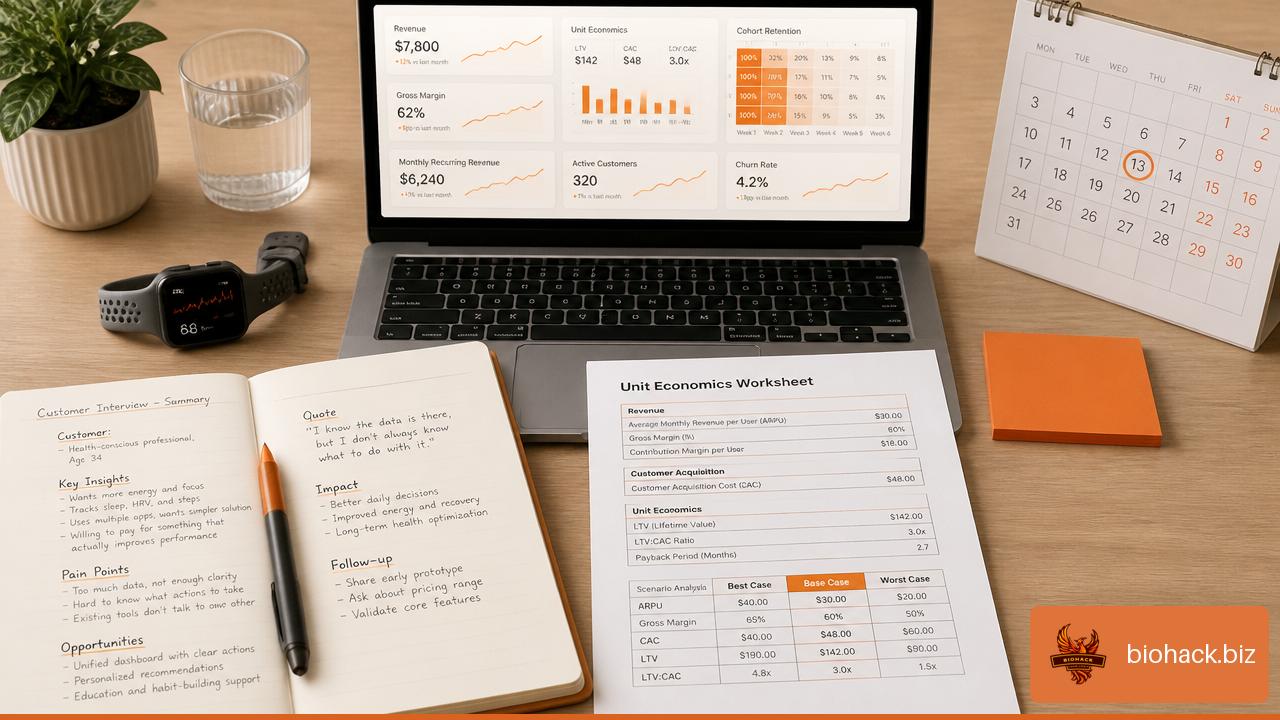
Revenue is not profit. A $99 digital program can look attractive until you account for payment fees, customer support time, refunds, software subscriptions, advertising, contractor help, and insurance.
Use this basic calculation:
Contribution margin per customer = price collected minus direct fulfillment costs, payment fees, refunds, support costs, and acquisition costs.
Consider a $149 group program. If payment fees average $5, software and materials equal $12 per participant, support time costs $20 per participant, refunds average $10, and customer acquisition costs $30, the contribution margin is $72. That may be viable. If acquisition costs rise to $90, the margin falls to $12 before you pay yourself for building the program.
This is why a business should not scale based only on follower counts. It should scale when delivery remains useful and each additional customer improves, rather than weakens, the operation.
A founder in a Reddit AMA about a biohacking and nootropics startup reported roughly $80,000 to $90,000 in monthly revenue after eight months of bootstrapping. It is an anecdotal, self reported number, not a forecast for a new home business. The useful lesson is not the revenue figure. It is the need to understand what is actually working before assuming growth will repeat.
Get Your First Customers Without Overpromising
Early marketing should teach people how you think, not pressure them to buy. Publish useful, narrow content around the exact problem your offer solves.
Build A Simple Trust System
Create content in three layers:
- Awareness content: Explain a common problem, such as why inconsistent wake times can make sleep tracking hard to interpret.
- Practical content: Share a worksheet, routine, or tracking prompt that a reader can use today.
- Invitation content: Offer a workshop, waitlist, consultation, or beta cohort to people who want structured help.
This structure is more credible than posting dramatic before and after claims. It also gives you market feedback. If people save a caffeine timing checklist but ignore your supplement post, that tells you what they value.
Protect Privacy And Set Expectations
If you collect wearable screenshots, questionnaires, habit logs, or biomarker information, treat it as sensitive. Request only what you need, explain why you need it, limit access, and avoid sharing identifiable details in testimonials without clear written permission.
Use written boundaries for every paid offer. State what is included, what is not included, when clients should seek medical care, how refunds work, and how communication happens. A client who expects clinical guidance from a wellness program can create confusion for both sides.
Consistency also matters. These 4 things successful biohack biz builders do differently can help you focus on practical habits that support long term business building rather than short bursts of activity.
Key Takeaways
- Start with one customer group and one wellness or performance problem.
- Choose lower risk offers such as education, digital tools, affiliate recommendations, or clearly scoped wellness coaching before building products.
- Keep medical, diagnostic, treatment, supplement, laboratory, and testing boundaries clear.
- Validate demand with customer interviews and a paid beta before investing in inventory.
- Document personal experiments carefully, but do not present them as clinical evidence.
- Track contribution margin, not just revenue, before increasing ad spend or expanding your offer.
- Build trust through transparent claims, clear disclosures, privacy practices, and realistic expectations.
FAQ
What Counts As A Biohacking Business?
A biohacking business helps customers explore wellness, performance, habits, self tracking, or educational tools. It may sell coaching, digital resources, workshops, affiliate recommendations, or products. The safest definition is one that clearly states what you provide and avoids implying medical treatment when you are offering wellness education.
Can I Start A Biohacking Business From A Home Office?
Yes, many models can begin from home. Content creation, digital products, group education, affiliate marketing, and administrative coaching work can be home based. Activities involving biological samples, hazardous materials, clinical testing, or regulated manufacturing may require facilities and rules beyond a home office.
What Is The Safest Model For A Beginner?
A narrowly focused educational offer or digital resource is usually the simplest starting point. It avoids inventory and lets you test customer interest. Add coaching only when you can clearly describe the boundaries of your support and referral process.
Do I Need Certification To Offer Biohacking Coaching?
Requirements can depend on where you live and what you do. A certification may improve your knowledge or customer confidence, but it does not automatically allow medical diagnosis or treatment. Check local rules and keep your scope centered on education, habits, and non clinical support.
Should I Sell Supplements Or Nootropics First?
Usually, no. Products add inventory, supplier, claims, fulfillment, and customer safety concerns. Consider starting with content, curated education, or affiliate recommendations while you learn what your audience actually needs. If you later sell products, use careful claims review and professional compliance guidance.
How Do I Get My First Five Customers?
Start with direct conversations in communities where your target audience already spends time. Offer a small, clearly scoped paid beta. Ask participants what outcome they want, what stopped them before, and what support they need. Use their feedback to improve the next version instead of trying to reach thousands of people immediately.
Can I Use Wearable Data In My Marketing?
You can discuss general trends and anonymized participant experiences with permission, but avoid presenting wearable data as diagnostic proof. A sleep score can be affected by device limits, behavior changes, illness, and other variables. Explain what the data can suggest and what it cannot confirm.
Conclusion
A home based biohacking business can begin simply: solve one clear problem, test a low risk offer, and earn trust through honest education. Resist the urge to sell a miracle protocol or buy inventory before demand is proven.
Start with a small beta, document what customers actually need, and improve the offer one cycle at a time. That is a more responsible path to building income, confidence, and a business that can grow without sacrificing safety.
Sources And References
• Reddit — AMA by a “biohacking” / nootropics startup founder: https://www.reddit.com/r/slatestarcodex/comments/b6r4ba/ama_by_a_biohacking_nootropics_startup_founder_he/
• Reddit — Want to start selling biohacking/longevity products, help?: https://www.reddit.com/r/HubermanLab/comments/1ixtdq8/want_to_start_selling_biohackinglongevity/
• Homegrown Futures — DIY Biohacking: Turn Your Hobby into Income: https://homegrownfutures.com/post/diy-biohacking-side-hustle-us-market
• Homegrown Futures — From Hobbyist to Pro: How to Turn DIY Biohacking into a Career: https://homegrownfutures.com/post/from-hobbyist-to-pro

Ready to Unlock Your Ultimate Potential—and an Additional Income?
Sign up today to instantly receive the first four chapters of our Biohack Your Life™ to “Own Your Life” ebook for free!
True biohacking isn’t just about optimizing your body and mind; it’s about claiming total autonomy over your time and your finances. If you're ready to boost your daily energy, sharpen your focus, and discover how to build an additional income, it’s time to take control.