Skip to content


A home business opportunity can give you more control over your schedule, income goals, and work environment. But the strongest opportunity is rarely the one with the boldest income promise. It is the one with a clear customer, a realistic way to reach that customer, manageable costs, and enough room to improve over time.
I recommend looking beyond the usual list of side hustles. A home based business is not simply something you can do from a laptop or spare room. It is a business model that needs demand, pricing, operations, and a plan for attracting customers.
TL;DR: Start with a service or offer you can sell before spending much money. Validate demand with real conversations and paid tests, calculate profit per customer, check local rules, and avoid opportunities driven mainly by recruitment or unrealistic income claims.
Key Takeaways
• The best home business opportunity for a beginner is often one that solves a specific problem for a specific customer.
• Service businesses can produce revenue faster than many product or content businesses because customers can pay before you build inventory.
• “Home based” does not always mean all work happens at home. Some models require travel, customer visits, storage, or local permits.
• Customer acquisition matters as much as the service or product itself. A business that is easy to deliver may still be hard to sell.
• Track revenue, direct costs, platform fees, refunds, taxes, and your time before deciding that an offer is profitable.
• Digital products, affiliate offers, content businesses, and network marketing can scale, but they usually require ongoing audience building and should not be treated as automatic passive income.

Choose the Right Type of Home Business Opportunity
The right opportunity depends on your available time, existing skills, financial cushion, comfort with selling, and local regulations. A flexible schedule sounds appealing, but flexibility does not remove the need for consistent work.
A useful first distinction is between a business that is administered from home and one that is performed entirely from home. Shopify explains that home businesses can include online, product, and local service models, including businesses that may involve inventory, employees, customer visits, or work away from the home. Shopify’s overview of home business models makes that distinction clear.
For example, an online bookkeeping service can be delivered from a home office. A dog walking business may be managed from home, but the revenue producing work happens elsewhere. A home bakery may make products at home, but it can require food safety compliance, packaging, delivery, and storage.
Compare Opportunities by Customer Acquisition Difficulty
Many people compare business ideas by startup cost alone. That matters, but it misses a more important question: How will you get the first ten paying customers?
| Business Model | Typical Revenue Path | Customer Acquisition Difficulty | Best Fit | Main Risk |
|---|---|---|---|---|
| Freelance service | Paid per project or hourly | Moderate | People with usable skills and outreach confidence | Trading time for income |
| Local recurring service | Weekly or monthly clients | Moderate | People willing to serve a defined local area | Travel and schedule limits |
| Digital product | Downloads, templates, courses | Often high at first | People with a clear audience problem to solve | Low visibility and copycat products |
| E commerce store | Product sales | Often high | People with sourcing, branding, or audience skills | Thin margins and returns |
| Print on demand | Product sales after an order | High | Designers and niche community builders | Platform fees and weak differentiation |
| Network marketing | Retail sales and, depending on the company, team commissions | Varies widely | People who can build relationships ethically and follow compliance rules | Overreliance on recruitment or inflated earnings claims |
A local cleaning service, for instance, may be easier to explain and sell than a digital course because the customer can immediately understand the value. The downside is capacity. One person can serve only so many homes each week.
An online template shop may have more scalability because the same file can be sold repeatedly. Yet it can take longer to attract buyers. You may need search traffic, an email list, partnerships, social content, or paid advertising before sales become consistent.
Start With an Offer, Not a Label
Instead of saying, “I want to start an online business,” write an offer that a buyer can understand in one sentence.
Examples include:
• “I create monthly social media posts for independent fitness studios.”
• “I provide virtual administrative support for local real estate teams.”
• “I sell editable wedding budget templates for couples planning small events.”
• “I help busy pet owners schedule weekly dog walking within a five mile service radius.”
The clearer the offer, the easier it is to test. It also helps you avoid broad, expensive branding work before you know whether anyone wants what you are offering.
For readers exploring several models, these ways to earn extra income from home can help frame the difference between short term income options and a business designed for repeat customers.
Validate Demand Before You Spend Much Money
A home business becomes less risky when you test demand before buying equipment, inventory, or expensive training. Research is useful, but interest is not the same as intent. Likes, compliments, and survey responses can be encouraging without producing sales.
Use a Four Week Validation Test
I suggest a simple test that creates a clear decision point rather than an endless planning cycle.
- Choose one buyer group. Do not target “small businesses” or “everyone who works from home.” Choose a narrower group, such as local accountants, new parents, or independent contractors.
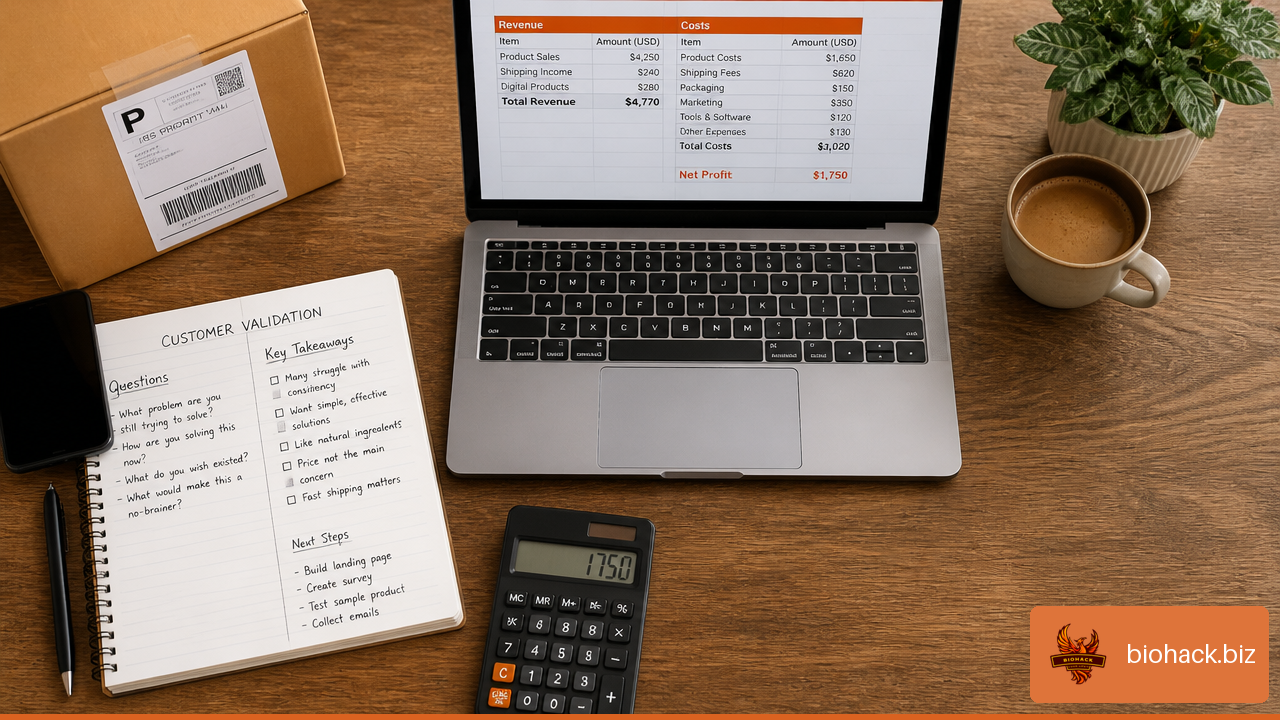
- Talk to ten potential customers. Ask what they currently do, what frustrates them, what they have tried, and what a better result would be worth. Listen for repeated language.
- Make one small offer. This could be a paid pilot, a preorder, a limited service package, or a paid consultation. Keep the offer narrow enough to deliver well.
- Set a pass or pause threshold. For example, aim for three paid pilots from 20 direct conversations, or ten preorders from 100 qualified visitors. If you do not meet the threshold, revise the buyer, problem, offer, or price before spending more.
Consider someone offering virtual assistant support to therapists. Instead of creating a large website and buying multiple software subscriptions, they might offer a two week appointment scheduling and inbox management pilot to three local practices. If no practice will pay for the pilot, the issue may be the offer or market, not the logo.
Use Unit Economics Before Scaling
Revenue is not the same as income. A $50 sale can lose money if payment fees, advertising, materials, delivery, refunds, and your labor cost more than the customer pays.
Use this basic calculation:
Contribution margin = Customer revenue minus direct variable costs
For a product business, direct variable costs may include product cost, packaging, shipping, marketplace fees, payment processing, advertising, and refunds. For a service business, they may include contractor support, travel, software used for delivery, and transaction fees.
| Example | Revenue Per Sale | Direct Costs | Contribution Margin | What It Means |
|---|---|---|---|---|
| Local pet sitting visit | $30 | $5 | $25 | Strong margin, but limited by available hours |
| Digital template sale | $18 | $4 | $14 | Good margin, but customer traffic may be difficult |
| Physical product sale | $45 | $31 | $14 | Margin may be too thin if advertising is needed |
| Virtual support package | $400 | $70 | $330 | Stronger margin if workload stays within planned hours |
Then add your time. If a $400 client package takes 20 hours to deliver, the effective gross return is $20 per hour before taxes and overhead. That may still be acceptable early on, but it tells you what must improve through better pricing, systems, or service scope.
Fair warning: there is no reliable universal dataset showing average profits or break even timelines for every home business type. Results vary sharply by skill, location, customer demand, and marketing ability. That is why a paid test is more useful than broad income promises.
Build an Operation That Can Support Growth
Once early buyers respond, the focus shifts from proving demand to delivering consistently. A business can fail even with customers if it has weak boundaries, messy finances, or too much dependence on one platform.
Handle Setup and Compliance Early
Xero notes that launching a home business commonly involves planning, registration, financial systems, and operational setup. Xero’s home business setup guidance also emphasizes tracking income and expenses from the start.
Your exact requirements depend on your location and business type. A general work from home label does not automatically give permission to serve clients at your residence, keep large amounts of inventory, prepare food, offer beauty services, or provide childcare.
Before launch, check these areas with your city, county, state, and insurer where relevant:
• Business registration and tax registration
• Home occupation permits or zoning restrictions
• Landlord or homeowners association rules
• Professional licensing requirements
• Food, childcare, beauty, or animal care regulations
• General liability, professional liability, product liability, or commercial auto insurance
A virtual coaching business may need relatively simple setup. A cottage food operation, in contrast, may face ingredient labeling, kitchen, sales channel, and inspection rules that vary by jurisdiction. The opportunity can still be worthwhile, but it must be evaluated as a regulated business, not just a hobby.
Protect Yourself From Platform Dependency
Marketplaces and social platforms can help you find customers quickly. They can also change fees, policies, rankings, or account access with little warning. Build on a platform if it provides demand, but do not let it become your only connection to customers.
A balanced approach is to use a platform for discovery while building assets you control:
• A customer email list collected with consent
• A basic website or booking page
• A customer relationship management system or organized contact list
• Repeat purchase offers, memberships, service retainers, or referrals
• Simple records of why customers buy and what they value
This is especially important for e commerce, content creation, affiliate marketing, and print on demand. These models can scale, but traffic is often the limiting factor. The work is not finished after a product is uploaded.
Treat Specialized Opportunities Honestly
Some opportunities look attractive because a single project can have a larger price tag. Yet higher prices usually come with higher delivery expectations. Forbes, for example, describes real estate virtual tour work that can involve a 360 degree camera, editing ability, local travel, and project prices around $200 to $500 per tour. Forbes’ examples of specialized home based work show why price should always be considered alongside equipment, expertise, and delivery constraints.
A $500 project sounds different after fuel, editing time, software, equipment depreciation, client revisions, and the time needed to find the next client. Higher ticket work can be excellent, but only when your capabilities and customer pipeline support it.
Evaluate Network Marketing With Clear Eyes
Network marketing is a home business opportunity that requires careful evaluation. A legitimate company should provide clear product information, written compensation details, realistic income disclosures where required, refund policies, and training that emphasizes customer value rather than pressure.
Avoid programs that make earnings sound guaranteed, require large inventory purchases, discourage questions, or focus mainly on recruiting people rather than serving retail customers. Any business involving commissions should be understood through its sales process, customer retention, expenses, and compliance obligations.
If you are considering this route, study practical network marketing tips for beginners while keeping the same standards you would apply to any startup: understand the product, know the costs, and build trust through honest communication.
Frequently Asked Questions
What Is the Best Home Business Opportunity for Someone Starting Part Time?
A service based business is often the most practical starting point because you can sell a defined result before buying inventory. Choose a service you can deliver in evenings or weekends, such as administrative support, design, tutoring, bookkeeping support, pet care, or local recurring help. Avoid offers with emergency response expectations if your current job limits availability.
Which Home Businesses Can Start With Less Than $500?
Freelance services, virtual assistance, tutoring, digital templates, consulting based on existing expertise, and some local services may start below $500 if you already have a computer, phone, and internet access. Keep the budget focused on basic legal setup, a domain or booking tool if needed, insurance where appropriate, and a small demand test. Do not spend the full amount before finding buyers.
What Home Business Opportunities Need No Inventory?
Service businesses, consulting, freelance work, tutoring, digital products, affiliate marketing, and some network marketing models can operate without storing physical inventory at home. No inventory does not mean no cost. You may still need software, marketing, training, insurance, or time to acquire customers.
Is a Service Business Easier Than an Online Product Business?
A service business is usually easier to validate because you can speak directly with potential customers and tailor an offer. An online product business may be more scalable, but it often needs more traffic before it produces steady sales. Choose services when you need faster feedback and products when you have a proven audience problem that can be solved repeatedly.
How Can I Tell if a Home Business Idea Has Real Demand?
Look for meaningful actions, not compliments. Paid pilots, deposits, preorders, booked calls, repeat purchases, and referrals are stronger signals than social media likes. Set a small test goal, such as three paying customers in four weeks, and revise the offer if buyers do not respond.
Do I Need a Business License to Operate From Home?
Possibly. Requirements depend on your business activity and location. A remote freelance service may have fewer restrictions than home childcare, food production, beauty services, pet boarding, or a business with frequent customer visits. Check local registration, zoning, permit, and insurance rules before opening.
Which Home Business Opportunities Are Usually Scams?
Be cautious when the offer promises guaranteed income, demands urgent payment, hides its compensation plan, relies mostly on recruitment, or gives vague details about the product or customer. A trustworthy opportunity should let you review costs, policies, risks, customer value, and cancellation terms without pressure.
Conclusion
A sustainable home business opportunity is built on proof, not hype. Start with a defined customer problem, test whether people will pay, calculate what remains after costs, and set up operations that respect your time and local rules.
You do not need a perfect plan before you begin. You do need a small, measurable next step. Talk to potential customers, make a focused offer, and let real feedback guide the business you build.
Sources/References
• Shopify — 23 Home Business Ideas for 2026 (+ How To Start): https://www.shopify.com/blog/home-business
• Forbes — 30 Home-Based Business Ideas With Growth Potential: https://www.forbes.com/sites/small-business/article/small-business-ideas-from-home/
• Xero US — Home Business Ideas You Can Start With Your Skills: https://www.xero.com/us/guides/home-business-ideas/

Ready to Unlock Your Ultimate Potential—and an Additional Income?
Sign up today to instantly receive the first four chapters of our Biohack Your Life™ to “Own Your Life” ebook for free!
True biohacking isn’t just about optimizing your body and mind; it’s about claiming total autonomy over your time and your finances. If you're ready to boost your daily energy, sharpen your focus, and discover how to build an additional income, it’s time to take control.