Skip to content


Financial freedom is not really a maths problem. It is a behaviour problem.
That is the big idea behind Morgan Housel’s The Psychology of Money. Money success has far less to do with complicated charts, clever predictions, and financial jargon than most people think. It comes down to how we behave, the risks we take, the risks we avoid, and the stories we tell ourselves about what money is for.
The goal is not simply to earn more or own more stuff. The real goal is to build enough control over your time that your life is yours to direct.
Managing Money Is About Behaviour, Not Just Knowledge
It is easy to assume that people who make financial decisions differently from us are being irrational. Someone saves every spare pound and avoids investing. Someone else takes risks that seem completely reckless. But “crazy” is usually the wrong label.
Every money decision is shaped by personal experience. A person who grew up in a recession, seeing their parents struggle to pay bills, may see cash as safety and risk as danger. Another person who came of age during an economic boom may have watched risk-taking lead to opportunity and reward.
Neither person necessarily lacks intelligence. They learned different lessons from different worlds.
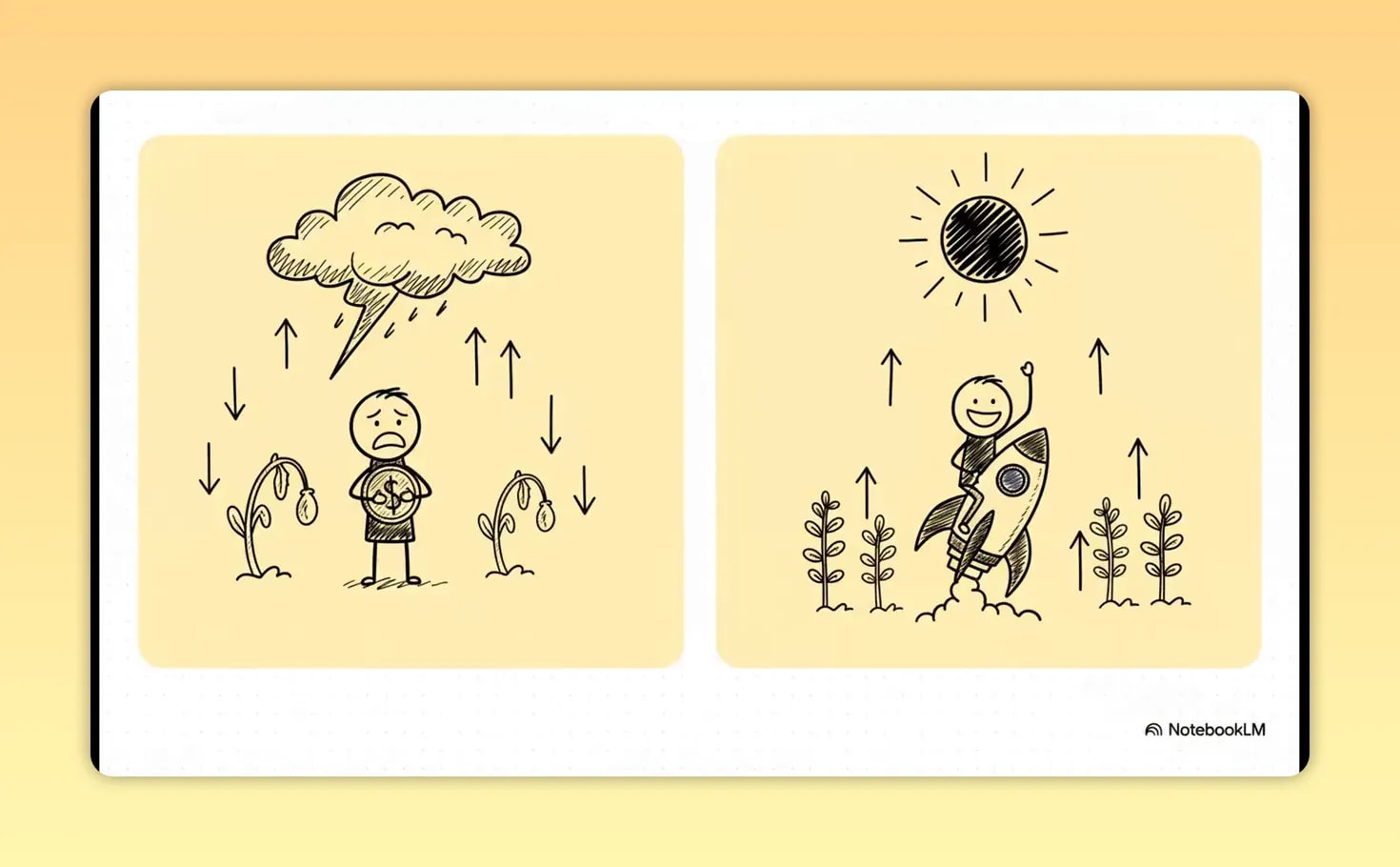
This matters because the best financial plan is not the one that looks perfect on paper. It is the one you can understand, live with, and stick to when life becomes uncertain.
The Invisible Forces: Luck, Risk, and Real Wealth
Some of the biggest forces in financial success are also the hardest to measure. Luck and risk are always in the picture, even when success stories make them invisible.
Success is never entirely self-made
Bill Gates was obviously brilliant and exceptionally driven. But he also had an extraordinary stroke of luck: his school had access to a computer in the 1960s, something almost unheard of at the time. That opportunity gave him an early advantage few people could access.
Then there is the brutal other side of the same story. Gates’s friend Kent Evans was similarly talented and shared his passion for computing. They had planned to build a company together, but Evans died in a mountaineering accident before finishing school.
The point is not to diminish achievement. It is to stay humble about it. Luck can open doors. Risk can close them. We should be careful about treating successful people as perfect templates or assuming that every setback is simply a failure of effort.
The man-in-the-car paradox
Here is another trap: buying visible things in the hope that they will earn admiration.
When people see a Ferrari, they usually admire the Ferrari. They do not spend much time admiring the driver. Yet it is easy to imagine that owning the car would make other people see us as impressive. That is the paradox.
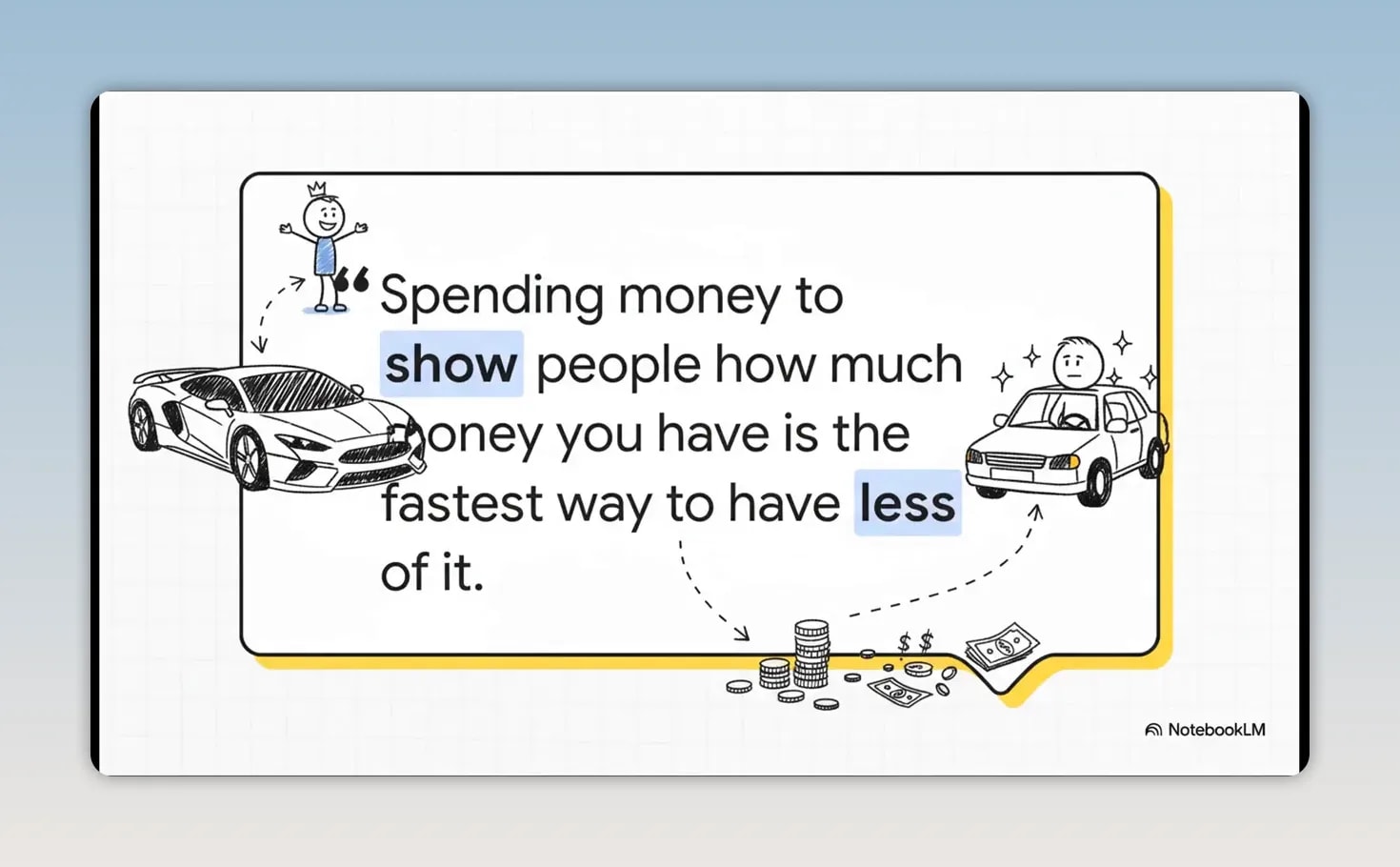
Being rich and being wealthy are not the same thing. Rich is often visible: the income, car, house, labels, and lifestyle. Wealth is largely invisible. It is the money not spent, the investments retained, the margin between income and expenses, and the choices that remain available to you.
Ronald Read, a janitor, quietly accumulated an $8 million fortune. He did not look like the stereotype of a wealthy person, but he had built something more important than a flashy image: financial freedom.
The Real Goal of Money Is Freedom
If more money is not mainly about showing off, what is it actually for?
The highest dividend money pays is autonomy. It is the ability to control your time. It is having a greater say over what you do, where you do it, and who gets access to your calendar.
This is why the chase for “more” can be so dangerous. Social comparison keeps moving the finish line. Rajat Gupta was worth more than $100 million, yet he became involved in insider trading while pursuing billionaire status. Bernie Madoff had a legitimate and successful business, but it was still not enough. In both cases, the inability to define “enough” had devastating consequences.
More is not automatically better if it costs your integrity, your peace of mind, or the freedom you were supposedly building towards.
Instead of asking, “How much can I accumulate?”, ask a better question: What would more control over my time allow me to do?
Do You Want to Learn How To Earn an Additional Income?
Start Owning Your Life
An Unbeatable Strategy: Let Time Do the Heavy Lifting
The strategy for building freedom is surprisingly simple. It has less to do with finding clever tactics and much more to do with temperament.
Warren Buffett is one of the clearest examples of the power of time. Around 90% of his net worth was earned after his 65th birthday. That is not just a story about investment skill. It is a story about being skilled, patient, and invested for more than 75 years.
Compounding needs time. The earlier you start, the more time you give your money, habits, and decisions to build on themselves. The important idea is not trying to perfectly predict every market move. It is spending enough time in the market for long-term growth to have a chance to do its work.
This is why consistency beats intensity. A decent plan followed for decades is more powerful than a flawless plan abandoned after a year.
Getting Wealthy and Staying Wealthy Are Different Skills
Building wealth often requires optimism and a willingness to take calculated risks. Staying wealthy requires something different: humility, caution, and respect for the fact that circumstances can change quickly.
Legendary trader Jesse Livermore made a fortune during the 1929 crash, equivalent to billions in today’s money. He mastered the skill of getting wealthy. But he continued making increasingly large bets and ultimately lost it all. He did not master the equally important skill of staying wealthy.
That is why survival matters so much. You do not need to be right all the time. You need to avoid decisions that knock you out of the game altogether.
Build room for error. Avoid taking risks so large that one bad outcome can destroy everything you have spent years creating. Staying in the game is what gives a long-term strategy the chance to pay off.
Be Reasonable, Not Perfectly Rational
Personal finance is personal. A spreadsheet may suggest that paying off a mortgage early is inefficient when the interest rate is only 3%. It may say that investing the money instead is the more rational decision.
But if paying off the mortgage helps you sleep peacefully at night, lowers stress, and makes it easier to stay committed to your broader plan, it can be the most reasonable decision available.
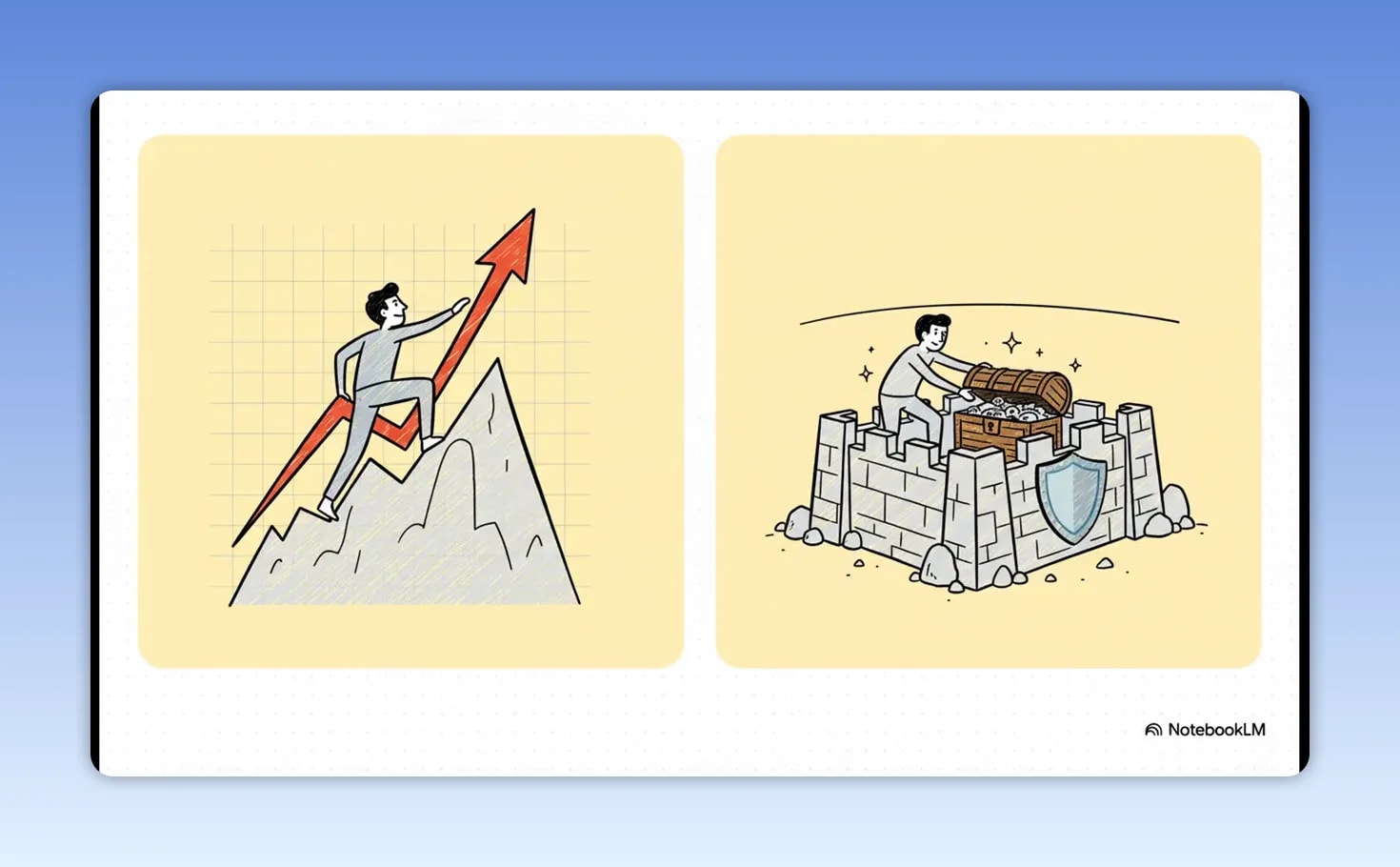
The plan you actually follow will always beat the theoretically perfect plan you quit. Financial decisions should work with your personality, your responsibilities, and your ability to remain calm during difficult periods.
Five Principles for Writing Your Own Money Story
There is no one-size-fits-all formula for financial freedom. There are, however, a few timeless principles worth carrying with you:
- Stay humble. Luck and risk are always part of the equation, no matter how successful or prepared you become.
- Choose time in the market over timing the market. Give compounding the time it needs to work.
- Aim for freedom, not flash. The most valuable form of wealth is control over your time.
- Be consistent. A sustainable strategy followed for years is stronger than an exciting strategy you cannot maintain.
- Focus on survival. Protect yourself from catastrophic losses so you can stay in the game long enough for your decisions to matter.
Define Success on Your Own Terms
These ideas go far beyond finance. They are really about values, happiness, and choosing what a successful life means to you.
Maybe freedom means more unhurried time with your family. Maybe it means the ability to build a business without burning out. Maybe it means leaving a job that drains you, creating a safety net, or simply having fewer financial worries at the end of the day.
Do not let somebody else’s car, income, title, or lifestyle decide what “enough” looks like for you. Build the habits, patience, and margin that allow you to own your time.
What is the financial story you want your money to help you live?

Ready to Unlock Your Ultimate Potential—and an Additional Income?
Sign up today to instantly receive the first four chapters of our Biohack Your Life™ to “Own Your Life” ebook for free!
True biohacking isn’t just about optimizing your body and mind; it’s about claiming total autonomy over your time and your finances. If you're ready to boost your daily energy, sharpen your focus, and discover how to build an additional income, it’s time to take control.